Mathematical modelling and numerical methods
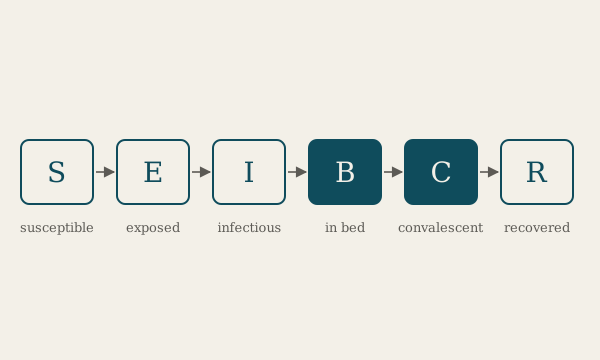
A compartmental model of the 1978 boarding-school influenza outbreak
The 1978 influenza outbreak in an English boarding school is still used to present and test epidemic models. The SIR model (susceptible, infectious, recovered) predicts 740 boys ill where 512 were; a model with separate states for the infectious boys, the boys in bed and the convalescent boys predicts 524 without being told the total.
Epidemic modelling
Calibration to data
Python
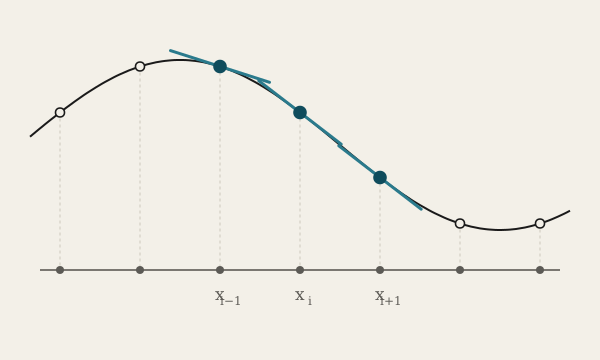
Compact finite-difference schemes on a uniform grid
Compact finite-difference schemes, which link the derivatives at neighbouring grid points, compute travelling waves far more accurately on the same grid. On a benchmark of computational aeroacoustics, a sound pulse that crosses 400 grid cells ends with an error of 61% of its height under the second-order central difference and 0.14% under the eighth-order compact scheme.
Numerical analysis
Wave propagation
Python

Physics-informed neural networks for a cylinder wake seen through dye and for an epidemic model
A physics-informed neural network, penalised wherever it breaks the equations of fluid motion, recovers the velocity, pressure and forces of a flow past a cylinder from a film of dye alone. Its pressure errs by 4.9% where optical flow and a flow solver adjusted to the film err by 53% and 62%; on an epidemic model that a numerical solver computes directly, it is no more accurate than least squares and costs about 200 times more.
Physics-informed neural networks
Fluid mechanics
Python